
Recording
Continuous vs Event Recording for IP Cameras
Compare continuous, event-triggered, and hybrid NVR recording policies for evidence coverage, storage use, review time, and reliability.
Continuous recording prioritizes coverage
Continuous recording reduces dependence on detection accuracy. If an event detector misses the start of an incident, the baseline recording may still contain it. The tradeoff is predictable, sustained storage and write bandwidth across every enabled camera.
Use a lower-bitrate stream when the purpose is situational history rather than fine identification. The recording should still have enough resolution and frame rate to answer the questions you expect to ask later.
Event recording prioritizes attention
Event clips reduce the amount of footage people must review and can preserve higher quality around important moments. Their weakness is the trigger boundary: detection can start late, stop early, or fire too often. Pre-event and post-event buffering help, but they do not make a detector infallible.
Review false positives by type and adjust motion regions, schedules, sensitivity, or object filters instead of disabling all event logic after a noisy day.
Why hybrid recording is often the best default
A hybrid design uses the sub stream for 24/7 coverage and the main stream for event evidence. That separates two goals: retaining broad history at a manageable bitrate and preserving more detail when something happens.
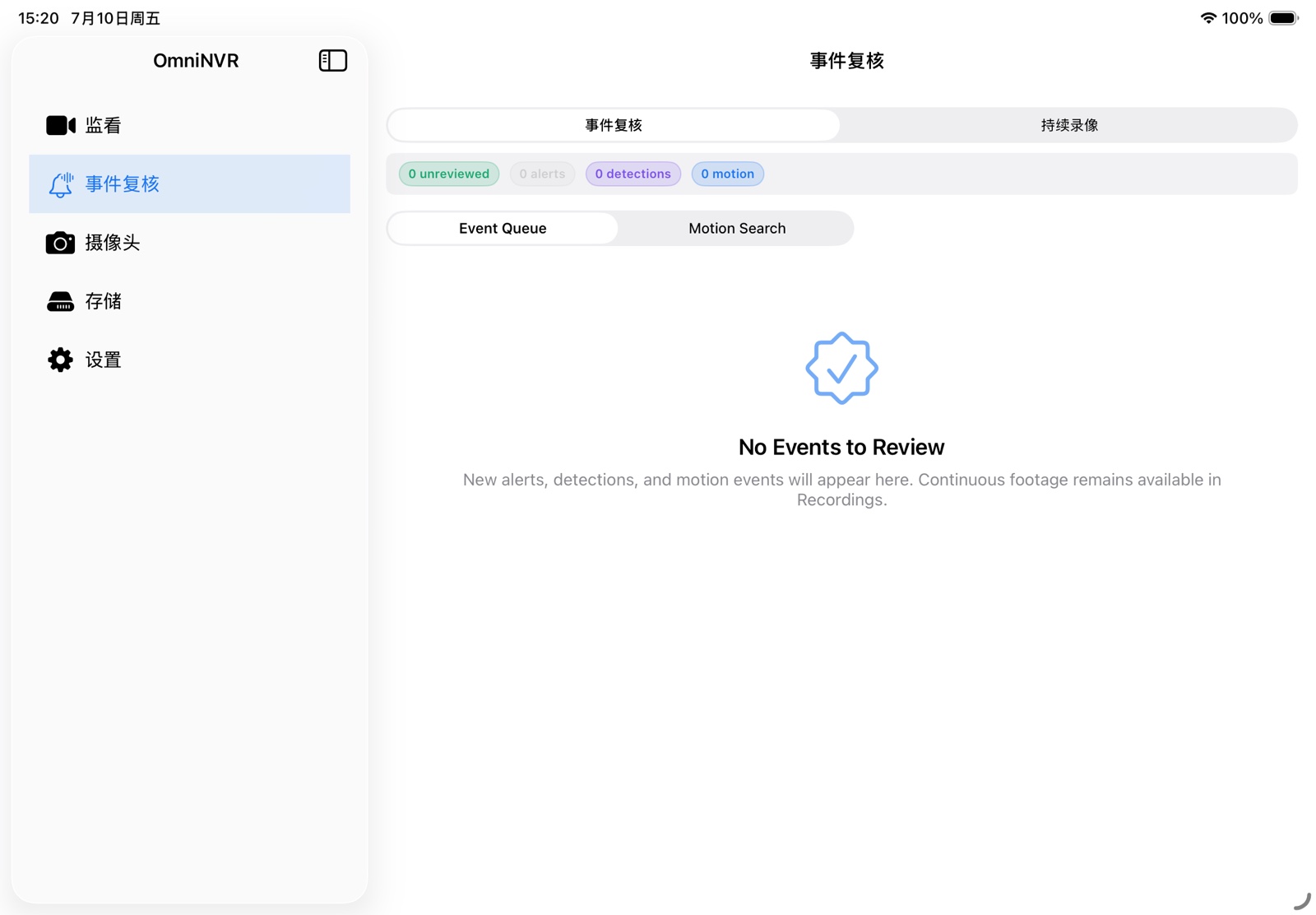
OmniNVR is designed around this split. The timeline can combine continuous segments and event markers so review starts with an alert but can move before or after it without leaving the recording context.
Choose policy by failure cost
- Home awareness: hybrid recording balances context and storage.
- Temporary monitoring: event-only may be sufficient if misses are acceptable.
- Operational evidence: continuous recording is safer when missing a period is costly.
- Privacy-sensitive areas: use schedules, masks, and the minimum necessary retention.
The correct policy is not the one with the most footage. It is the one whose known failure modes match your risk and review workflow.
Frequently asked questions
Does event recording save a lot of storage?
It can, but savings depend on scene activity, detector sensitivity, clip length, and false positives. Busy scenes may produce nearly continuous events.
What is pre-event recording?
It preserves buffered video from before the trigger so the clip includes the lead-up. The available duration depends on the recorder implementation and memory policy.
Can continuous and event recordings use different quality levels?
Yes, when the camera exposes suitable main and sub streams and the recorder can assign them to different roles.
Build your NVR on the Apple devices you already own.
Monitor, record, review, and retain RTSP and ONVIF camera video locally.